Over the course of Lecter's life, the instrumentalization of drugs transforms him from a traumatized orphan into a more sophisticated man who is immune to drugs and no longer haunted by his past. In Hannibal Rising, Lecter tries to handle his childhood trauma by consuming thiopental sodium and hypnotics. Influenced by these drugs, Lecter regresses into his repressed childhood memory. However, in Red Dragon, the older Lecter cannot be influenced by drugs. According to Graham, the FBI agents used "sodium amytal" as a truth serum on Lecter "to find out where he buried a Princeton student" (126). Lecter was not influenced by the drug, though, and instead sent the FBI to dig up a spot where he had buried a recipe (126). So, as Lecter ages, he becomes immune to drugs following his drug-assisted serial killing in the prequel, which complicates the conventional understanding of drugs as having the power to enslave their users. Alcohol is a symbol of Lecter's transformation. The younger Lecter weaponizes alcohol to assist his vengeance, whereas the older Lecter instrumentalizes it to demonstrate his high taste and to heal traumas, suggesting that the older Lecter becomes more sophisticated. Thus, in Hannibal, Harris draws on the positive and healing associations of alcohol as a pharmakon to indicate Lecter's transformation from a miserable orphan to a refined sophisticate. Drugging Starling is essential for Lecter's transformation because the words of the drugged Starling heal his trauma. As O'Brien argues, "Hannibal and Clarice engage in mutually beneficial psychotherapy sessions" (154). During Lecter's drug therapy, he tries to substitute Starling's personality with that of Mischa. Under the influence of hypnotics and alcohol, Starling says to him, "there's room in me for my father, why is there not room in you for Mischa?" (Hannibal 536). Starling means that she can keep her deceased father in memory without being obsessed with the memory, and Lecter should do the same to his deceased sister. Starling's words almost change Lecter's mind because "Dr. Lecter seemed pleased, whether with the idea, or with Starling's resource is impossible to say" (536). According to O'Brien, "both orphaned at an early age, Hannibal and Clarice Starling belong together, two lost souls in need of healing" (154). Lecter and Starling bond with each other based on childhood traumas and therefore can show empathy to each other and heal each other. As Gompf claims, by the end of Hannibal, Lecter and Starling "have cured each other" (133). By the end of his life journey, Lecter is no longer haunted by the death of Mischa: "For many months now, he has not seen Mischa in his dreams" (Hannibal 544). According to Gompf, "Lecter may possibly, while still maintaining and acknowledging an evil side, no longer act upon it, having progressed beyond these actions" (134). Indeed, it is reasonable to speculate that the cured Lecter may stop the drug-assisted serial killing. By the end of Hannibal, he is more at peace than in Hannibal Rising and therefore is transformed.
Meanwhile, Lecter's instrumentalization of drugs also transforms Starling from a capable FBI agent who fights against evil into his lover, sister, mother, and accomplice. As Rieger mentions, "through a process of intense psychoactive and hypnotic therapy, Hannibal has either transformed Clarice or facilitated her transformation" (100). Before being drugged, Starling spares no effort to catch criminals and fights for justice. Nevertheless, after being drugged, she is cooperative when Lecter tries to replace her personality with that of Mischa. During the cannibalistic feast, the drugged Starling tells Lecter that she and Mischa "could be like sisters" (Hannibal 536), suggesting that Starling is willing to play the role of his sister. Moreover, the last chapter of Hannibal indicates that Starling, under the influence of drugs, has sex with Lecter: "Sex is a splendid structure they add to every day" (543). As Szumskyj puts it, "in an almost dreamlike sequence, hypnotized, drugged and semi-willingly to follow her mentor, Starling becomes Lecter's friend, lover, and pending on interpretation, pseudosister" (208). Influenced by hypnotics and alcohol, Starling acquires these roles, demonstrating the mind-altering effect of these drugs. By breastfeeding Lecter, Starling also plays the role of his mother. The drugged Starling breastfeeds Lecter as she thinks that Lecter had to relinquish his mother's breast to Mischa when he was a child. As Simpson notes, Starling "metaphorically becomes the generous, giving, and loving mother denied to him by the circumstances of his life" (219). While breastfeeding Lecter, she takes "warm Chateau d'Yquem from her mouth" and places it on her breast for him to lick (Hannibal 536-537). Chateau d'Yquem functions as an intoxicant for both Starling and Lecter. Because the wine is shared by them and is consumed at a moment when Starling becomes the pseudo-mother and Lecter becomes the pseudo-son, it symbolizes their mutual transformation. Furthermore, the drugged Starling becomes a cannibalistic monster and Lecter's accomplice, demonstrating the transformative power of drugs. Harris gives hypnotics and alcohol agency by making them central to Starling's metamorphosis.
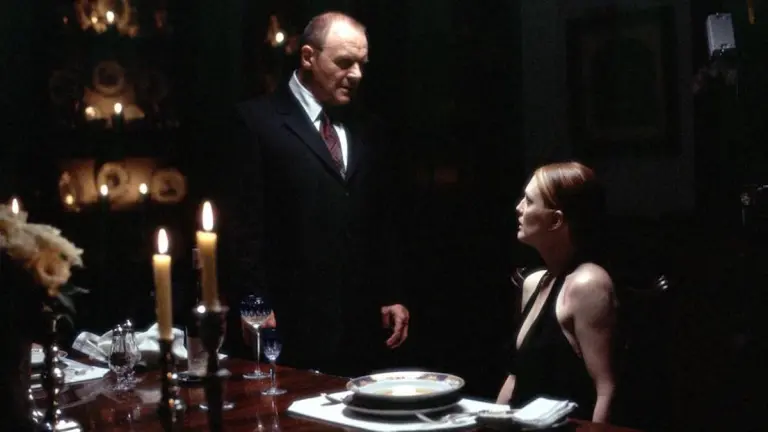
Unlike such mediocre serial killers as Gumb and Dolarhyde who have difficulty maintaining romantic relationships, Lecter successfully creates a companion for himself through his forceful administration of drugs into Starling's body. Goodrich asserts that Lecter has "the basic, fundamental need for companionship. Lecter knows he is unlikely to meet anyone like himself, and so he must make someone" (47). Lecter's instrumentalization of hypnotics and alcohol to transform Starling demonstrates his longing for companionship and makes him more complicated than conventional serial killers who are blood-thirsty "alienated loners" (Simpson 6). Due to Lecter's longing for companionship and his empathy for Starling, readers tend to sympathize with him, and the tendency is problematic because it is part of the phenomenon of "celebrity Lecter". Harris critiques this tendency by underscoring how Lecter's forceful administration of drugs violates Starling's agency.